

Download our demo
app from
Google Play to see Fingerprint in action!
Device Identifier
When the Fingerprint Identification SDK is integrated into your mobile app, it will collect several attributes from the device. With the help of these attributes and additional algorithms, Fingerprint is able to provide a unique device identifier (i.e.visitorId) for every device on which your app is installed.
Did you know?The device identifier generated by the Android SDK (embedded within your mobile app) will be different from the visitor ID generated by the Javascript agent (embedded within your website).
visitorId does not persist.
For your reference, we have listed various scenarios where a visitorId will remain the same before and after and where a new visitorId will be created.
Android Smart Signals
Smart Signals are actionable device intelligence signals that help you to make informed decisions about the device and thus prevent fraud. These signals could be used as input to your machine learning models behind your fraud detection or risk mitigation engines. For example, when you know that a request is originating from a rooted device or from a recently factory reset device, you will be able to take additional precautionary security steps (e.g. multi-factor authentication). For Android, the following Smart Signals are available:- Android Emulator Detection
- Cloned App Detection
- Factory Reset Detection
- Frida Detection
- Geolocation Spoofing Detection
- IP Geolocation Detection
- IP Blocklist Detection
- MitM Attack Detection
- Rooted Device Detection
- Tampered Request Detection
- VPN Detection
- Developer Tools Detection
- Smart Signals common for browsers and mobile devices
Fingerprint Identification SDK for Android
Current Version: 2.17.1
For release notes and older versions, visit our Changelog for Android SDK page.Supported Versions
The minimum version that the Fingerprint Identification SDK for Android supports is Marshmallow, API Level 23 starting Android SDK 2.11.0+. Per Google, this will allow your app to be compatible with a wide variety of active Android devices.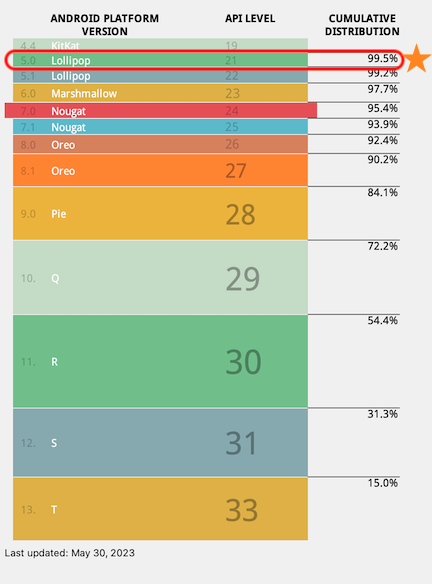
Required Permissions
Fingerprint Identification SDK for Android requires the following normal permissions, without which the SDK cannot function properly. These permissions are required to identify the device and provide additional intelligence.android.permission.INTERNETcom.google.android.providers.gsf.permission.READ_GSERVICES
Getting Started Guides
Our Getting Started guides are aimed at helping you to easily integrate our SDK with your apps.- For native Android apps, see Mobile SDKs > Android and our Android quickstart.
- For apps built using Flutter, see our Flutter SDK on GitHub and our Flutter quickstart.
- For apps built using React Native, see our React Native SDK on GitHub and our React Native quickstart.
Data Safety Requirements for Google Play
For every app that is uploaded to the Google Play Store, Google requires that the app’s privacy and security practices are made available to all its users. For this reason, when an app (or a new version) is uploaded to the Play Store, Google requires app developers to fill out a data safety form. See Provide information for Google Play’s Data safety section for more information. If your app includes our Android SDK, then you can use the following as a reference to fill out the data safety questionnaire:Section: Data collection and security
- Does your app collect or share any of the required user data types? Yes
- Is all of the user data collected by your app encrypted in transit? Yes
Section: Data types
- Select all of the user data types collected or shared by your app
- App info and performance -> Diagnostics
- Device or other IDs.
- Location -> Precise and Approximate Location (collected since Android SDK v2.10.0+; requires user consent for permissions)
Section: Data usage and handling
Note: The Data sharing section in the Google Play Data Safety form can be left empty. Per Google’s policy, data transferred to a service provider that processes it on the developer’s behalf - in compliance with the developer’s instructions, contractual terms, and privacy policies - does not need to be declared as “shared.” As Fingerprint acts as a data processor under GDPR (and a service provider under Google’s definition), data sent to Fingerprint does not constitute “data sharing” for the purposes of this form.
Google Play Compatibility Notes
The Fingerprint Android SDK may not be compatible with Google Play’s Automatic Integrity Protection. If your app uses Google Play’s integrity protection, we recommend reviewing compatibility before enabling this feature. If both are enabled, this may result in false positives or unexpected app behavior.FingerprintJS-Android: Open-source identification for Android
We also provide a lightweight, open-source library called fingerprintjs-android which is available to use for free by everyone. Our commercial SDK, Fingerprint Identification for Android, is based on our well-maintained, free, open-source library. Compared to the open-source library, our commercial SDK collects many more attributes from the device. It also uses advanced fingerprinting and matching algorithms to create a unique device identifier. For your better understanding, here is a complete set of differences between our open-source library (fingerprintjs-android) and our commercial SDK (fingerprint-android-pro).
**In comparison to fingerprints, VisitorIDs are more accurate and stable identifiers because they are deduplicated, are processed further on the server, and utilize fuzzy matching. On the other hand, fingerprint hashes become unstable across time intervals greater than 2 weeks because they rely on an exact match of all browser attributes.
***The company, Fingerprint, in its role as data processor is compliant with GDPR, US Privacy Laws (including CCPA) and SOC 2 Type II. It is also ISO 27001 certified. As a data controller, it is still your responsibility to be compliant with GDPR and US Privacy Laws (including CCPA) and use the identification result for legitimate purposes.
Understanding privacy manifest files