

The benefits of using a custom subdomain
- Significant increase in accuracy in browsers with strict privacy features such as Safari or Firefox.
- Ad blockers can’t block the JavaScript agent. Most ad blockers stop requests sent to an external URL, but allow requests sent to an internal URL like a subdomain.
- Cookies are recognized as “first-party.” This means they can be saved in the visitor’s browser and used to reliably identify visitors when third-party cookies are blocked completely (for example, Safari blocks all third-party cookies).
- Fingerprint becomes harder to detect. Requests made directly to the Fingerprint domain are easy to detect. Routing through a subdomain on your own domain makes Fingerprint harder for automated blockers and fraudsters to detect.
Limitations of the subdomain integrationSince Safari 16.4, cookie lifetime in Safari is reduced to 7 days when using the custom subdomain setup. To keep cookies lasting up to one year in Safari, use a cloud proxy integration such as the Cloudflare proxy integration.
1. Register your custom subdomain
To use a custom subdomain, the connection between your site and Fingerprint must be secure, so Fingerprint registers every subdomain with an SSL certificate. Each workspace can have up to 50 unique subdomains. During your free trial, you can use up to 5. If you need more than 50, contact the support team. To start, go to Settings > Subdomains and select New subdomain.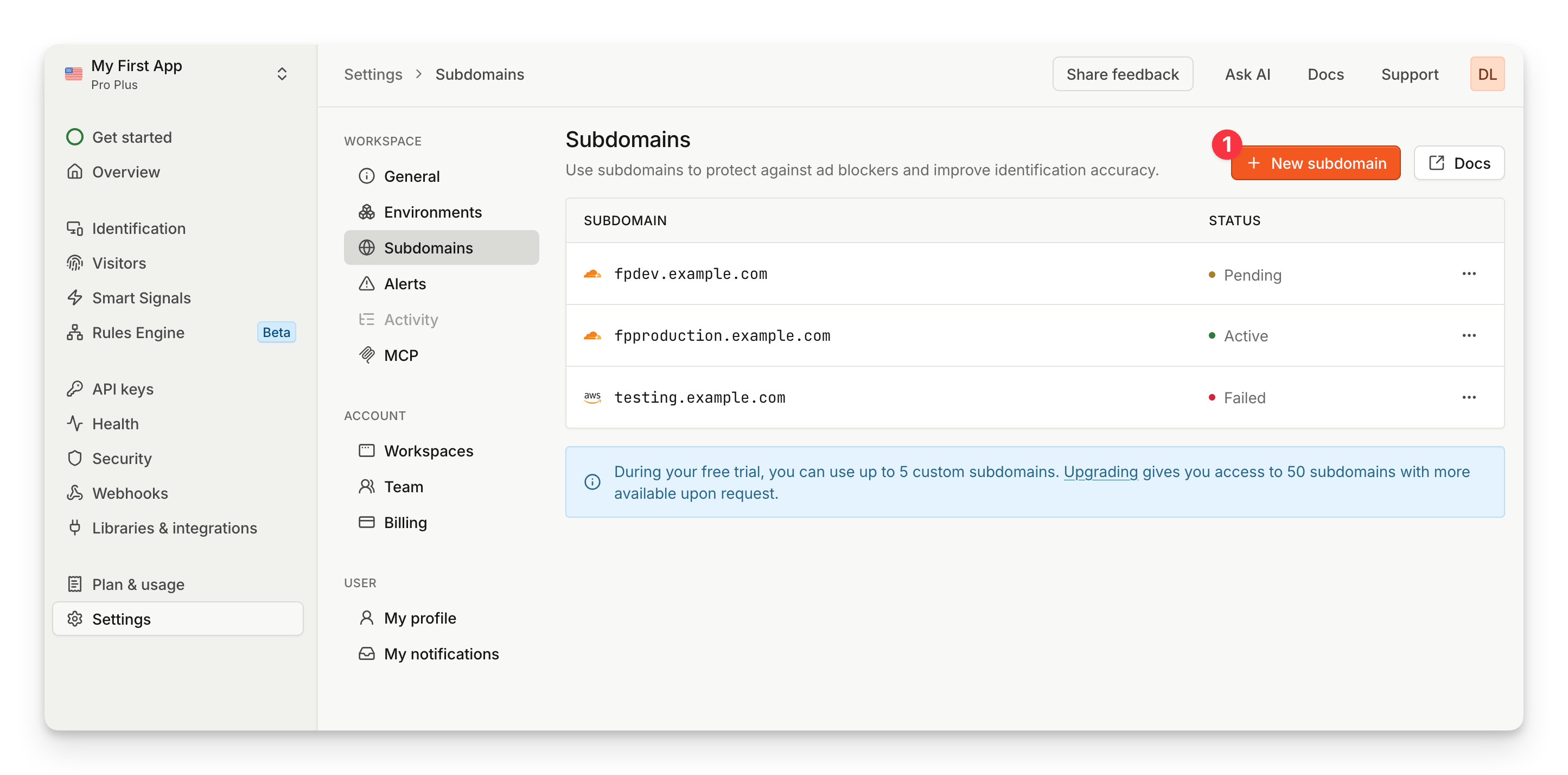
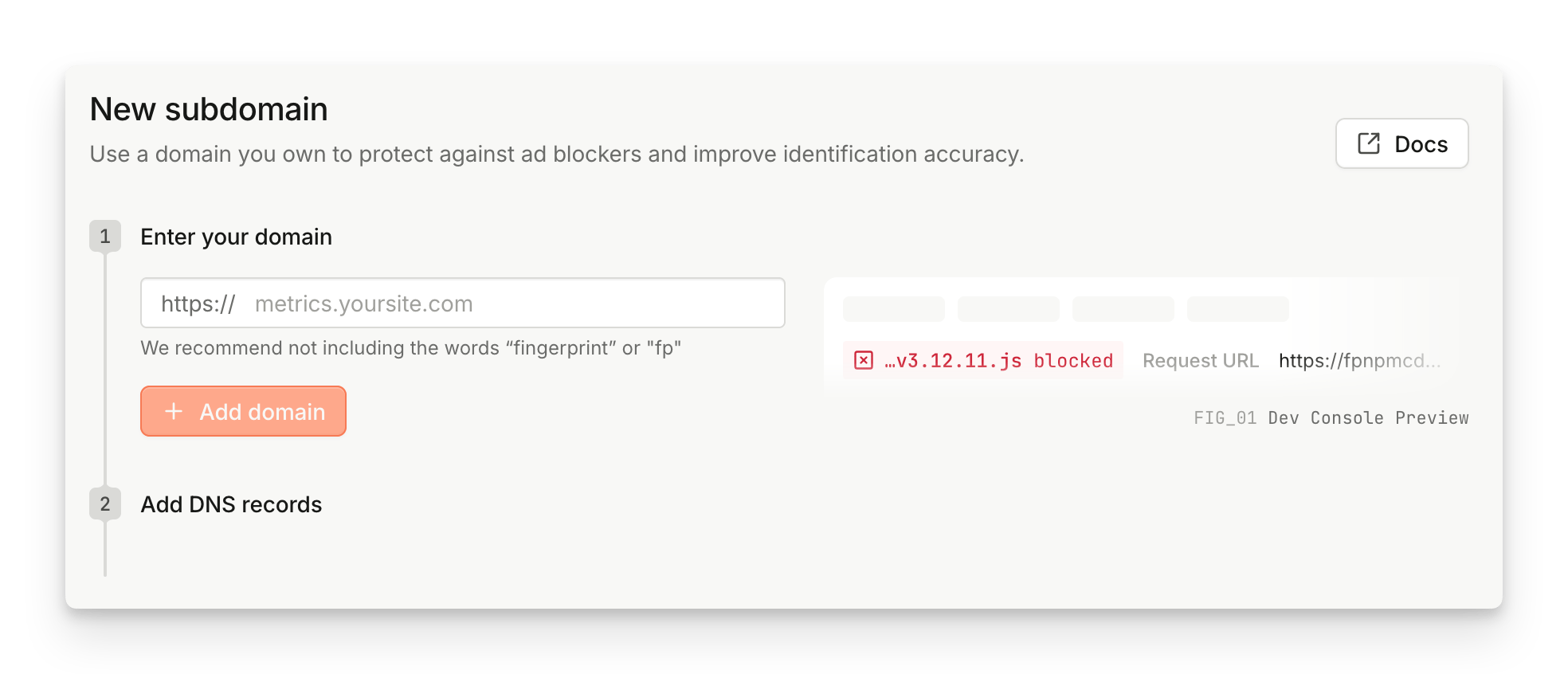
- Use the subdomain only for sending requests to Fingerprint.
- Match the subdomain’s primary domain to the request origin. For example, use
metrics.yourwebsite.comwhen you run Fingerprint onyourwebsite.com. - Avoid the words
fingerprintandfpin the subdomain name. Names likefingerprint.yourwebsite.comorfp.yourwebsite.comare easier for ad blockers to detect and block. Use a neutral name likemetrics.yourwebsite.cominstead.
2. Add DNS records
After you add your domain, the dashboard shows every DNS record you need in one place:- One CNAME record verifies that you own the domain.
- Two A records route identification traffic to Fingerprint.
You can add the two A records right away. They start routing traffic once your certificate is issued.
Subdomain statuses
Each subdomain shows one of these statuses:- Pending: Fingerprint is validating your DNS records and issuing the SSL certificate. This can take up to 24 hours. To confirm a record was added correctly, run
dig HOST +shortin your terminal, using the host value of the record. If the record is set up correctly, its value is returned. - Active: Your records are validated and the certificate is issued. Your subdomain is ready to use.
- Failed: The records were found, but the certificate can’t be issued. This usually happens when a conflicting CAA record blocks Fingerprint’s SSL provider (Cloudflare) from issuing certificates. Add the CAA record shown in the dashboard, wait for it to propagate, then delete the failed subdomain and add it again.
Using Cloudflare as your DNS provider?
- Disable DNS proxying for all records associated with your subdomain.
- Cloudflare sometimes adds CAA records that aren’t visible in the DNS panel. To see them, run
dig caa yourwebsite.com, replacingyourwebsite.comwith your domain. - Cloudflare’s CNAME flattening can prevent CNAME validation from working. Disable it if you have validation issues with Cloudflare DNS.
3. Configure the JavaScript agent
Once your subdomain is active, update the JavaScript agent configuration.- Update the
endpointproperty. - Update the URL pattern used to download the agent (
scriptUrlPatternfor NPM packages or theimportURL when using the CDN directly).
defaultScriptUrlPattern and defaultEndpoint as fallbacks. The JavaScript agent will continue working even if your custom subdomain becomes unavailable.
Notes:
- The endpoint subdomain should match the domain of your website.
- If you use a Content Security Policy on your website, add the custom subdomain to the
connect-srcdirective of your policy. See the CSP guide for more details. - If you issued a wildcard SSL certificate, the URL shows an asterisk, for example
*.yourwebsite.com. Replace the asterisk with the subdomain you plan to use, for examplemetrics.yourwebsite.com.
Frequently asked questions
I completed the setup. How can I add more subdomains?
To add more subdomains, add them individually at any time:- Go to Settings > Subdomains and select New subdomain.
- Repeat the setup steps for each new subdomain.